Reading a Public Proposal: Find the Question, Options and Next Step
Reading a public proposal clearly means finding the decision being requested, comparing the options actually named and locating the next stated step.
A notice about a new street crossing lands beside the grocery list, and its first paragraph describes a problem before asking for a decision. Reading a public proposal clearly starts by separating that background from the question officials or residents are being asked to answer. The distinction matters: a document can explain a concern, present alternatives and describe a process without asking readers to approve the whole project.
What is the proposal asking someone to decide?
Look for the sentence that names an action and its decision-maker. It may ask a council to authorize design work, invite residents to choose among layouts, or request comments before staff prepare a recommendation. Those are different requests, even when they concern the same place.
Useful clues include verbs such as approve, select, authorize, recommend, comment on and consider. Find the subject of the verb, too. “The board will consider a revised route” does not mean residents are being asked to select that route; “please comment on the proposed route” identifies a different role for the reader.
Write the request in a plain sentence for yourself: “The council is being asked to…” or “Residents are being asked to…” If the document does not let you finish that sentence without guessing, mark the request as unclear rather than filling the gap with an assumption.
Which parts are background and which parts are the request?
Public documents often begin with context: a recurring complaint, a maintenance issue, a planning constraint, or a previous decision. Context can explain why an item appears on an agenda, but it does not itself establish what action is proposed now.
Look for labels such as “purpose,” “recommendation,” “options,” “staff report,” “motion,” or “next steps.” Then check how the sections relate. A recommendation may appear in an executive summary while the formal motion sits in an attachment; an invitation to comment may be separate from a later vote. Headings help locate material, but the actual wording tells you what it does.
Dates and verbs can also distinguish stages. A proposal “under consideration” is not necessarily approved, and a draft design is not necessarily the design being adopted. Keep the document’s status separate from its subject: what is being discussed may be settled in one respect and still open in another.
How do you identify the options actually offered?
Count only the alternatives the document names as available for the decision at hand. A report might describe three layouts, recommend one, and state that a “no change” option is outside the current scope. The recommendation is not an additional option, and an alternative mentioned only as past history is not necessarily on the table.
For each named option, note what changes and what stays the same. A compact comparison can prevent an attractive rendering or a brief label from standing in for the details:
- Option name: Use the document’s wording so you can match your notes back to it.
- Proposed action: Record the change the option would make.
- Unchanged elements: Note features the document says remain as they are.
- Stated limits: Capture any condition, exclusion or dependency the proposal names.
- Decision status: Mark whether it is an option for decision, a recommendation, or background.
Do not infer that every possible alternative has been considered. A short list may be deliberately limited to choices within a particular scope. If the document does not say whether other options can be raised, that is a question about the process, not evidence that an unlisted option is impossible.
What does the proposal say happens next?
Find the sentence that describes the next action, then identify who is expected to take it and what event triggers it. The next step might be staff review of public comments, a committee recommendation, a council vote, or preparation of a revised plan. A stated sequence is more useful than a general phrase such as “the proposal will move forward.”
Separate a scheduled event from a promised outcome. An agenda listing may show when a matter is expected to return, but it does not by itself say what decision will be made. Likewise, a promise to “report back” describes a further communication, not necessarily approval or implementation.
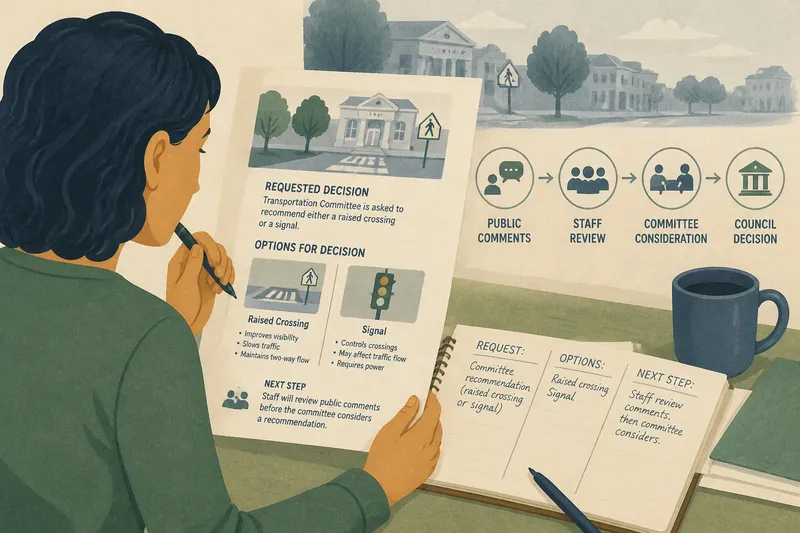
Say you receive an invented notice about a crossing near a library. It asks the transportation committee to recommend either a raised crossing or a signal, while a staff summary says comments will be reviewed before the recommendation reaches council. You could record the requested decision as “committee recommendation,” the stated options as “raised crossing” and “signal,” and the next step as “staff review, then committee consideration.” That wording preserves what the notice says without deciding which design is better.
How can you check a proposal when its wording is unclear?
Does a recommendation mean a final decision?
Not necessarily. A recommendation is often advice for another person or body to consider, while a final decision may require a separate motion or vote. Look for the named decision-maker and the action the document says that body will take.
Are public comments the same as choosing an option?
Usually, a request for comments invites people to share views or information; it does not by itself transfer the decision to commenters. Check whether the document separately describes a vote, selection process or formal recommendation.
What if the proposal lists no alternatives?
Record that the document presents a single proposed action, rather than inventing a comparison. You can ask whether alternatives are still open for consideration and where that question should be directed.
Where should you look for a missing next step?
Check linked agenda materials, staff reports, meeting minutes or the public body’s published procedure, if those are available. If the sequence remains unstated, ask the relevant clerk or staff contact which body acts next and whether another decision is scheduled.
What is not worth inferring from a proposal?
A polished map does not reveal which option will be adopted, and the order of options does not reliably show priority. A forceful description of a problem does not settle the decision, either. Those details may affect how a reader feels, but they cannot substitute for the document’s request, named choices and stated process.
It is also not worth treating every sentence as a hidden signal. Focus on language that assigns an action, defines an alternative, identifies a decision-maker or sets out a next step. If a point depends on a term you do not recognize, note the term and ask what it means in that document rather than guessing at a broader implication.
How can you keep a useful reading note?
Keep the note brief enough to check later: the requested decision, the decision-maker, the options actually named, the next stated action, and anything the document leaves unanswered. Include the document title or agenda item so you can find the source again. This is not an assessment of the proposal’s merits; it is a record of what the proposal says.
When you return to a public proposal, use the same order: identify the request, distinguish background from formal action, list only the stated options, and trace the next step to its actor. Reading a public proposal this way gives you a firmer basis for asking a precise question, even when the document leaves part of the process open.