Why Public Benches Face More Than One Way
Why public benches face more than one way: choose seating direction and grouping that support watching, conversation, or a comfortable pause.
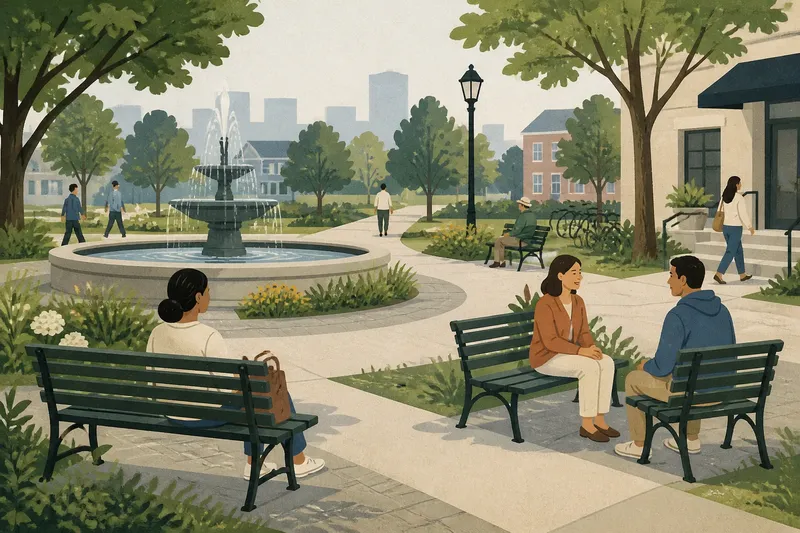
At a small plaza, one bench points toward the fountain while another turns toward the path. That difference is not decoration. Public bench placement can invite a person to watch, talk, or sit apart for a moment, and the right choice depends on what the space asks people to do.
A bench is a modest piece of civic design, but its direction sets a social cue. A line of seats facing a view offers company without requiring conversation; seats turned toward one another make conversation easier. Good placement starts by noticing how people already use a place, then deciding which kind of welcome is missing.
Choose the view when the space offers something to watch
In a park beside a pond, garden, playing field, or busy public path, turn seating toward the activity. A person can settle in without having to join it. This works especially well where visitors may arrive alone, wait for someone, or take a quiet break.
Set the bench so the view is clear but the seat does not obstruct the route people use to reach it. Leave the main approach open, and consider what a seated person sees at eye level: a planted border may look inviting from standing height but hide the view from the bench. Shade, wind, and afternoon glare also affect whether a good view feels comfortable.
Facing a path can support casual people-watching, though it can also make sitters feel displayed if the walkway is narrow or heavily used. Angle the seat slightly away from direct foot traffic when a more sheltered pause would suit the space. The point is not to conceal users; it is to let them look outward without feeling that every passerby must look back.
Turn seats together when people need to talk
For a courtyard, community garden, or waiting area where visitors commonly arrive in pairs, a small group of seats can make conversation feel natural. Two benches facing one another work when there is enough room to pass between and around them. A loose L-shape can feel less formal and still allow people to see one another.
Avoid arranging every seat as if it belongs to a single group. Some visitors come alone, and some conversations are private or brief. Pair a conversational arrangement with a separate seat facing a view or open space, so joining others remains an option rather than an expectation.
Say a neighborhood plaza has one bench facing a blank wall and people tend to wait there in pairs. The local steward might propose turning that bench toward a second seat and leaving another bench pointed toward the trees. The expected visible result is a choice between sitting with a companion and sitting independently, rather than one arrangement trying to serve both needs.
Keep a solo pause distinct from a social invitation
At a library entrance or along a quiet garden edge, a bench placed slightly apart can make room for a pause without signaling exclusion. It should still feel connected to the public space: keep it visible from ordinary paths, near the activity it serves, and accessible without crossing a planting bed or stepping into a busy route.
Spacing matters as much as orientation. Seats placed shoulder to shoulder encourage a shared row; a little separation gives people a choice about proximity. Avoid creating isolated pockets that are difficult to reach or impossible to see from nearby public areas. A solitary seat can offer quiet while remaining part of the common setting.
What is not worth the effort is turning every bench toward the same supposedly perfect landmark. Views change with seasons, events, and everyday activity. A flexible arrangement usually serves more people than a rigid row designed around one moment.
Match bench placement to the situation you see
- People stop to watch a recurring activity: Face seats toward it, with an unobstructed view and a clear route behind or beside them.
- Visitors often arrive in pairs: Use a facing or L-shaped arrangement, while keeping at least one seat apart from the group.
- People wait near an entrance: Place seating close enough to make the waiting point obvious, but outside the path through the doorway.
- The walkway feels exposed: Angle the bench toward a garden or open view rather than directly at passing feet.
- Users need both company and quiet: Combine a small conversational group with a separate outward-facing seat.
These are starting points, not fixed prescriptions. Walk the site from the approaches people actually use. Notice where someone carrying a bag would pause, where a stroller needs to pass, and whether the bench faces noise, glare, or a useful view. For installed seating, local access requirements and the product’s installation instructions can affect placement; check those before changing a public fixture.
Which bench direction fits your public space?
Should a bench face a path?
It can, when watching activity is part of the appeal and passersby have room to move comfortably. If the path is narrow or the seat feels exposed, turn it toward an adjacent view instead.
Are benches better in pairs or groups?
Pairs and small groups suit places where conversation happens naturally, such as a courtyard or garden gathering area. Keep an independent seat nearby so the arrangement does not make company feel compulsory.
How should a bench face in a waiting area?
Orient it toward the place people are waiting for, such as a building entrance or pickup point, without blocking the approach. A second seat angled away can give visitors a quieter option.
How can a bench feel welcoming to someone alone?
Offer a clear view, a comfortable sense of space, and a position connected to ordinary activity rather than hidden behind it. A seat that does not demand eye contact can make a pause feel easier.
When considering public bench placement, ask what a person should be able to do from the seat: watch, speak with someone, or rest without joining in. That simple question helps a space offer several forms of belonging, each visible in the way the benches meet the paths around them.