The Open-Door Assumption: Why Attendance Is Not Participation
Public meeting attendance becomes more meaningful when the room, agenda, and speaking rules help newcomers understand the discussion and join it with confidence.
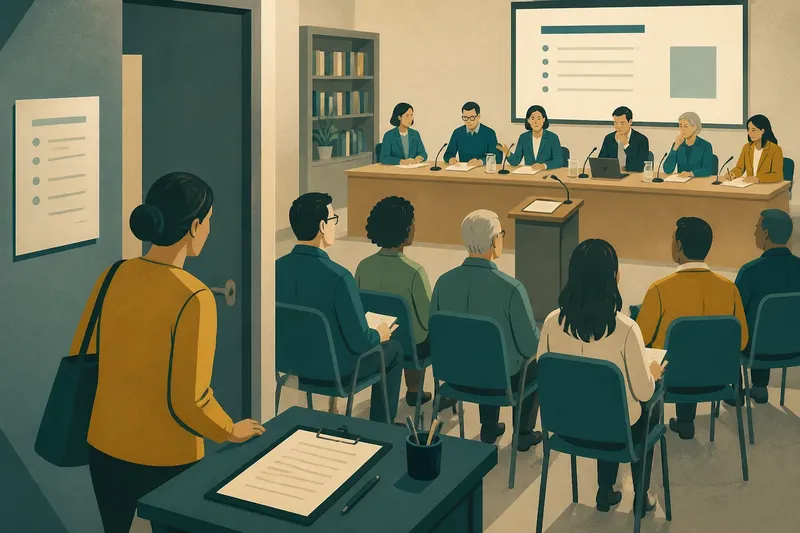
A resident slips into a library meeting room as the chair moves to the next agenda item. The sign-in sheet sits beside the door, and a microphone waits at the front. The meeting is public, but the moment to speak has passed. Public meeting attendance, in that room, means being present without having a clear way into the conversation.
A seat can help someone understand how a local decision is made. It does not by itself tell them what is being decided, which details matter, or how to follow the discussion. Those are questions of meeting design, not simply access.
Public meeting attendance depends on more than an open door
“Open to the public” describes who may enter. It does not explain the purpose of the meeting or the conventions that shape it. A notice might list a room and start time but leave a newcomer unsure whether the session is a presentation, a working discussion, or a formal hearing.
That uncertainty grows when members rely on acronyms, refer to earlier conversations without context, or move quickly between agenda items. Regular attendees may recognize the shorthand; someone arriving for the first time may spend the meeting trying to work out what is happening.
A short orientation can close that gap. The chair or facilitator can say what decision is under discussion, explain unfamiliar terms, and identify when the public may ask questions or comment. Clear cues make the room easier to follow even for people who do not intend to speak.
The room’s design shapes who can follow along
People participate differently depending on how well they can hear, see, and understand the proceedings. A microphone that is used inconsistently, a screen that is hard to see from the back, or a packet written only in technical language can turn attendance into guesswork.
Practical choices help: test the room’s sound, make the agenda easy to find, offer a plain-language explanation of the topic, and say where people can ask for interpretation or accessibility support. If a meeting has a remote option, explain how participants can follow the current agenda item and signal that they want to contribute.
Time and setting matter, too. A long session without a break can be difficult to follow, while a meeting scheduled at a time that conflicts with work or caregiving can keep interested residents away. Organizers cannot remove every barrier, but they can make the format and its limits clear.
Some visible touches are not worth the effort if the basic experience remains confusing. Elaborate name tags or a polished slide deck do little for someone who cannot hear the discussion or tell what the agenda item means. Start with sound, orientation, and plain language.
Notice whether the meeting invites questions or comments
A meeting can make space for different kinds of public involvement. A facilitator might pause for clarifying questions during a presentation, invite short comments at the end of an item, or set aside a formal public-comment period. These formats are not interchangeable: a question helps someone understand, while a comment expresses a view or concern.
When no clear invitation is given, newcomers may hesitate to interrupt or may assume that speaking is not allowed. The chair can prevent that confusion by explaining the format before discussion begins and repeating it when the meeting moves to a new kind of agenda item.
Imagine a resident who attends a library board discussion about a proposed change to room reservations. The agenda names the proposal but does not explain whether questions are welcome. The chair opens by saying that questions will follow the staff presentation and comments will be heard before the board discusses its options. The resident can then save a question about the new process for the presentation and offer a separate view during the comment period; the observable result is a contribution that fits the meeting’s stated format.
What should a first-time attendee look for?
How can I tell whether the meeting is easy to follow?
Look for a posted agenda, a clear explanation of the topic, and a chair who names each item before discussion begins. If those cues are missing, ask the facilitator or clerk to identify the current item and explain any unfamiliar terms.
Can I ask a question without making a formal comment?
That depends on the meeting’s format. Listen for the chair’s instructions, or ask whether questions are welcome during discussion or only at a designated point.
What can I do if I cannot hear or follow the presentation?
Ask the chair to repeat a point or speak into the microphone, and request any available interpretation or accessibility support. If the presentation relies on a document, ask where to find it so you can follow along.
How can I tell whether remote participation is workable?
Check whether the notice explains how to join, follow the agenda, and signal a request to speak. If those instructions are unclear, contact the organizer before the meeting and ask what participants can do if the connection fails.
Small observations can point to a better meeting
Someone who attends can notice where the experience becomes difficult without taking responsibility for redesigning the institution. These observations are most useful when they name a concrete moment and its effect, rather than treating a single awkward meeting as proof that nobody is welcome.
- If the chair begins without naming the agenda item, ask for a brief orientation; if the item remains unclear, request a plain-language explanation before discussion continues.
- If speakers cannot be heard from the back of the room, ask that the microphone be used; if the sound still fails, request a repeat or a written copy of the presentation.
- If an acronym appears without explanation, ask what it means; if the answer introduces more jargon, ask for the point in everyday language.
- If the agenda is hard to find, ask the clerk where it is posted; if no copy is available, request the item titles aloud so you can follow the sequence.
- If the chair moves on without explaining whether questions are welcome, ask when questions may be raised; if there is no question period, ask whether the facilitator can clarify a point after the meeting.
- If remote attendees cannot tell which item is underway, ask the organizer to announce each transition; if that does not help, request that the current item be repeated in the chat or meeting materials.
These are prompts for noticing and asking, not a demand that every attendee take on the work of the chair. Organizers remain responsible for making the basic structure understandable.
Public meeting attendance can feel different when the format is clear
Imagine a first-time visitor arriving at a neighborhood planning session with a printed agenda and a question about a map. The room has a microphone, but the chair has not explained how questions work. The visitor asks the clerk, who says the facilitator will pause after the map presentation. When that pause comes, the visitor asks about a street label and receives a direct explanation before the group moves on. The starting point was uncertainty; the actual steps were checking the agenda, asking the clerk, and waiting for the announced pause; the result was a question answered within the meeting’s format. The same process would not work if the chair had set aside no question period, so the visitor would need to ask about another suitable time instead.
That distinction matters. Public meeting attendance is not a promise that every concern will shape a decision, and a clear format cannot make every meeting equally accessible. It can, however, help people understand what they are hearing and how to take part without having to guess at the rules.
When choosing a meeting to attend, look beyond the address and start time: a useful notice tells you what the room is for and how its conversation works. That small piece of preparation can make public meeting attendance less like watching an insider’s routine and more like being able to follow the work in front of you.